For years, schools have been held back by outdated, fragmented administrative systems. Student records are stored in paper files, attendance is marked manually, results are calculated by hand, and fees are tracked in notebooks or scattered spreadsheets. Teachers spend hours recording marks and compiling reports instead of focusing on teaching and mentoring students.
Administrators face daily pressure to manage admissions, fees, examinations, and reporting across disconnected tools that don’t communicate with each other. Small errors in records lead to disputes, lost data, delayed reports, and unnecessary stress for school staff.
This administrative burden doesn’t just waste time; it affects the entire school ecosystem. Parents struggle to get clear information about fees, attendance, or academic performance, while school leaders lack real-time insight to make informed decisions.
As schools grow, these inefficiencies multiply. Manual processes become harder to manage, transparency declines, and scaling operations becomes a challenge. Instead of supporting education, administration becomes an obstacle.
In a world where schools are expected to be faster, more accountable, and more connected, relying on paperwork and disconnected systems creates barriers that keep schools from reaching their full potential.
The question worth asking is: why does this keep happening, and what would it take to fix? To answer that, it helps to look at the specific position private schools in Juba occupy and the opportunity in front of schools that get their systems right.
The Fundamental Problems With Manual School Administration
The frustrations described at the start of this post are not isolated complaints. They are structural, and they show up the same way in school after school.
Paper-based records. Student files, enrollment forms, and academic histories are often kept in physical folders or exercise books. A single misplaced file can mean a lost transcript, a delayed transfer, or a student’s academic history simply disappearing. There is no backup, no search function, and no way to update a record without physically finding and editing the original page.
Manual attendance and hand-calculated results. Attendance registers filled in by hand can’t be automatically aggregated into term-long patterns. Grades entered by hand into report cards must be added, averaged, and ranked by a person one student and one subject at a time. This process consumes days of teacher time every term and is highly prone to arithmetic error.
Notebook and spreadsheet-based fee tracking. Fee collection is frequently tracked across multiple notebooks, receipt books, and unconnected spreadsheets maintained by different staff. Reconciling what has actually been paid, by whom, and through which channel (cash, mobile money, or bank transfer) becomes a manual detective exercise every time the numbers need to be checked. “I already paid” disputes are common and hard to resolve conclusively.
Disconnected tools. Even schools that have adopted some digital tools often use them in isolation: a spreadsheet for fees, a separate one for grades, a printed register for attendance none of which share data. Administrators end up re-typing the same information into multiple places, and no one ever has a complete, current picture of the school.
Disputes, lost data, and delayed reporting. All of the above compound each other. A parent disputes a fee balance and there is no clean audit trail. A new head teacher arrives and inherits a system nobody can fully explain. Each of these moments consumes time and trust that a fee-funded institution can’t afford to lose.
The Human Cost: Why Teachers Need a Digital School Management System
The deepest cost of manual administration is what it takes from teachers and for a school, teacher quality is precisely what parents are paying a premium for. Every hour a teacher spends compiling report cards by hand or manually tallying attendance is an hour not spent preparing lessons or supporting a struggling learner.
What Happens When Schools Grow Without the Right Systems
Manual systems don’t just stay inconvenient; they get worse with scale. A school with 150 students can, with enough effort, keep track of fees and marks on paper. A school with 800 students across multiple classes and streams, boarding facilities, and several income streams cannot do the same without the error rate, the disputes, and the reporting delays multiplying along with enrollment. For a private school looking to open a second campus, add boarding capacity, or keep pace with rising demands, growth is supposed to be the reward for doing well. Under a manual system, it becomes the very thing that breaks it.
Proof That School Management Software Works: Lessons From the Region
It’s fair to ask whether a digital school management system is realistic in a lower-income, infrastructure-constrained environment. The evidence from the region says yes.
In Rwanda, UNICEF has spent more than five years supporting the Ministry of Education’s transition of its school data systems from a paper-based process to a fully digital, web-based one. A central part of that effort, the School Data Management System (SDMS), now gives individual schools a live snapshot of enrollment, staffing, and classroom numbers visible to school leaders and education authorities alike. Head teachers interviewed by UNICEF in 2025 described the shift in direct terms: paperwork has been reduced significantly, data errors have dropped because information is recorded and updated in real time, and even routine administrative tasks, like requesting a school’s funding for feeding programmes, are now handled directly through the system rather than through paper-based bureaucracy. One head teacher who had worked in school administration both before and after the rollout described the change as night and day.
The lesson isn’t that Juba’s private schools need to import a foreign, complicated piece of technology. It’s that a neighboring country facing many of the same infrastructure constraints has already shown that digitizing core school administration is achievable and that it pays off in exactly the areas schools here struggle with most: paperwork, data accuracy, and decision-making.
Why AcademiaPro Is the School Management System Built for Juba
This is precisely the gap AcademiaPro was built to close not as a generic, one-size-fits-all platform, but as a school management system designed around the realities of running a private school in Juba.
Centralized, secure student records. Every student’s academic history, enrollment details, and subject enrollment live in one searchable, backed-up system instead of a folder that can be lost, damaged, or misfiled. Each school’s data is kept in its own secure space within the platform, so records stay private to that institution.
Automated attendance and results. Attendance is captured digitally and results are computed automatically once marks are entered, eliminating the hours teachers currently spend on manual tallying and report compilation time that goes back into teaching, exactly where parents expect it to be spent.
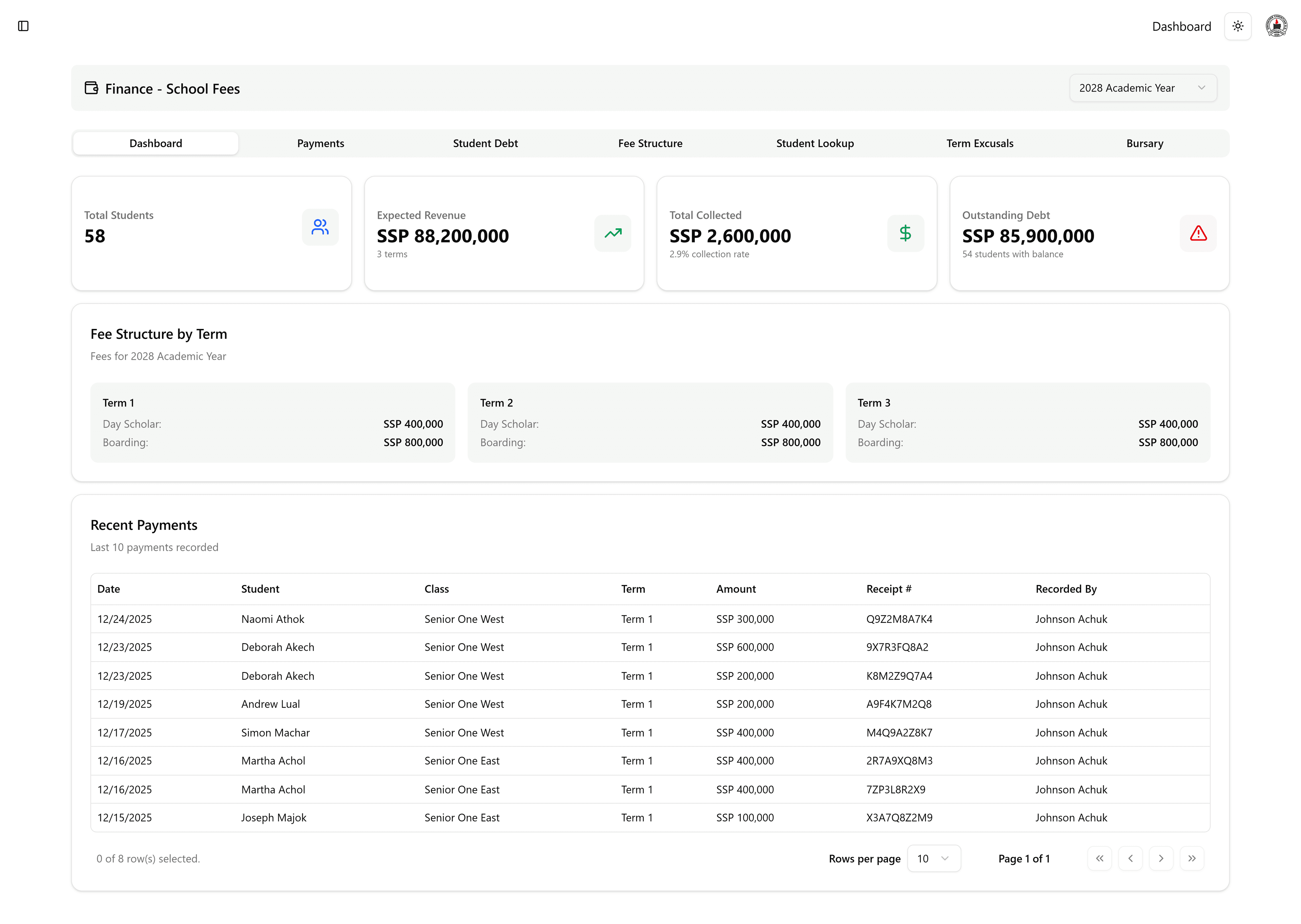
Fee management built for how Juba’s private schools actually get paid. AcademiaPro’s fee module is built around structured payment reference codes and automated bank reconciliation, so a payment made through a bank can be automatically matched to the right student and the right invoice. This closes the gap that causes “I already paid” disputes and gives the school a clean, defensible fee record in a climate where fees are already under scrutiny.
Role-based access for real accountability. The platform is built around seven distinct roles: Super Admin, Admin, Class Teacher, Teacher, Bursar, Boarding Warden, and Librarian. Each role sees only the information relevant to their responsibilities. A bursar can manage finances without exposing academic records; a class teacher can manage a class without needing access to school-wide finances. This creates the kind of clean audit trail that resolves disputes quickly.
Real-time insight for school leadership. Instead of waiting for someone to manually compile a report, school leaders can see enrollment, attendance, fee collection, and academic performance as they happen.
Transparency for parents. Parents gain direct visibility into their child’s fee balance, attendance, and academic progress, replacing the current pattern of having to visit the school or wait for a printed report to know how their child is doing. It’s a small change that goes a long way toward justifying the trust and the fees parents are already placing in the school.
The Bigger Picture: The Opportunity for Private Schools in South Sudan
Private education in Juba isn’t a shrinking niche. It’s where many families are already placing their trust and money—often because there is no functioning public alternative nearby. That demand isn’t going away, and the schools positioned to capture it are the ones that can prove, consistently, that they deserve the fees they charge: reliable teaching, transparent finances, and records a parent, a regulator, or a new head teacher can actually trust.
Reputation in this market travels by word of mouth and by results, just as the gap between private and public exam performance became public knowledge in 2022. A school that runs on clean data can defend its fees, resolve disputes quickly, open a second campus with confidence, and point to real numbers when it explains to prospective parents why it’s worth choosing. A school still running on notebooks is exposed on every one of those fronts, no matter how good its teachers are.
South Sudan’s wider education challenges are real and will not be solved by software alone. But the part of the problem that lives inside the school gate—the paper files, the hand-calculated results, the notebook ledgers, the disconnected tools—is solvable. And similarly resourced systems in the region have already shown it can be fixed. Private schools in Juba don’t have to wait for anything else to change to start improving what’s within their control.
AcademiaPro is built for exactly that: a school management system designed around the way private schools in Juba actually operate, so that administration goes back to supporting education instead of standing in its way.
Frequently Asked Questions
What is a school management system? A school management system is software that centralizes a school’s core administrative functions such as student records, attendance, results, and fee collection into a single connected platform, replacing paper files and disconnected spreadsheets.
Why do schools in Juba need a school management system? Schools in South Sudan operate in a market where parents pay significant fees and expect reliability in return. A school management system gives schools accurate, defensible records for fees and academics, frees up teacher time, and builds the kind of transparency that protects a school’s reputation.
Is AcademiaPro available outside Juba? AcademiaPro is available to schools outside South Sudan.
Does AcademiaPro handle school fee payments? Yes. AcademiaPro reconciles bank payments automatically using structured reference codes, matching each payment to the right student and invoice without manual cross-checking.
Sources